

There’s a frustrating moment almost every moving-company owner has experienced.
A new lead comes in.
Someone on your team calls.
The customer answers.
You collect the move details.
Maybe you even send an estimate.
Then… nothing.
A few days later, you find out the customer booked with another moving company.
The natural reaction is:
“That was a bad lead.”
Sometimes it was.
But sometimes the lead wasn’t bad at all.
The customer actually needed a mover. They were in your service area. Their move date worked with your schedule. They had the right type of move. They had a legitimate budget.
They simply chose somebody else.
That distinction matters because the solution is completely different.
If you’re receiving bad leads, you have a lead-quality problem.
If you’re receiving good leads but losing them after they contact you, you have a conversion problem.
And spending more money on leads won’t fix a conversion problem.
In fact, if your sales process is leaking customers, buying more leads can simply give you more opportunities to lose.
You Didn't Lose the Lead. You Lost the Customer
A lead is not a customer.
That’s the first distinction every moving company needs to make.
A lead is an opportunity to start a sales conversation.
A booked move is the result of successfully moving that opportunity through the sales process.
Between those two points, a lot can happen.
A customer can:
- Call three other movers.
- Receive five estimates.
- Decide your price is too high.
- Decide your website doesn’t look trustworthy.
- Get frustrated because nobody follows up.
- Choose the company that answered first.
- Prefer the mover who explained everything clearly.
- Choose the company that made scheduling easier.
- Stop responding altogether.
- Decide to postpone the move.
- Book with a competitor before your salesperson ever calls.
This is why simply counting leads can give a moving-company owner a completely misleading picture of marketing performance.
Consider two hypothetical moving companies.
Company A
- 50 leads
- 35 qualified
- opportunities
- 25 estimates
- 8 booked moves
Company B
- 30 leads
- 24 qualified opportunities
- 20 estimates
- 12 booked moves
Company A generated more leads.
Company B booked more moves.
If you only look at lead volume, Company A appears to be doing better.
If you look at the actual business outcome, you get a very different picture.
The question isn’t:
“How many leads did we buy?”
The better question is:
“What happened to every lead after we received it?”
What Happens After a Moving Lead Hits Your Phone?
This is where many moving companies lose money without realizing it.
Imagine a homeowner submits a moving quote request at 10:14 AM.
Your team receives the notification.
Nobody calls until 11:03.
The customer is already talking to another mover.
That mover asks about the move.
They explain the process.
They provide an estimate.
They follow up.
Your salesperson eventually gets through and says:
“Hi, we received your request for a moving quote.”
The customer responds:
“Oh, yeah. I already booked someone.”
You might call that a bad lead.
But what actually happened?
The lead was there.
The opportunity was there.
The customer needed a mover.
The sales process simply started too late.
Current moving-lead providers explicitly emphasize real-time delivery and speed because shared leads can be sent to multiple moving companies, meaning the homeowner may be contacted by competing movers around the same time.
That creates a simple reality:
The lead doesn’t wait for your sales team to get organized.
The Same Lead Can Be Worth More to One Mover Than Another
Here’s something moving-company owners should think about.
Two companies can receive essentially the same type of lead and get completely different results.
Why?
Because the value of a lead isn’t determined only by the person who submitted the form.
It’s also determined by what happens after submission.
Company A might:
- Respond quickly.
- Ask the right qualifying questions.
- Explain the estimate clearly.
- Make the customer comfortable.
- Have strong reviews.
- Have a professional website.
- Follow up consistently.
- Make booking simple.
Company B might:
- Respond hours later.
- Give a vague quote.
- Sound rushed on the phone.
- Never follow up.
- Have poor online credibility.
- Make the customer chase them for information.
Both companies received an opportunity.
Only one turned the opportunity into revenue.
This is why “lead quality” should never be evaluated without looking at lead handling.
Shared Moving Leads Create a Race
There’s another issue owners need to understand when evaluating purchased leads.
Not every lead is exclusive.
Some lead providers sell shared leads to multiple moving companies. Current providers publicly describe shared leads being distributed to two, four, or more movers depending on the product.
That means the homeowner can potentially be talking to several companies about the exact same move.
Now imagine this:
- You receive the lead at 2:00 PM.
- Your competitor receives it at 2:00 PM.
- Another mover receives it at 2:01 PM.
- The customer isn’t sitting around waiting for your company to call.
- They’re trying to solve a problem.
They want to know:
- Who can move me?
- How much will it cost?
- Are they available?
- Can I trust them?
- How difficult will this process be?
And the company that makes those questions easiest to answer has an opportunity to win the job.
This doesn’t mean shared leads are automatically bad.
It means you need to understand what you’re buying.
If you’re paying for a shared lead, you’re not necessarily buying exclusive access to a customer.
You’re buying an opportunity to compete for that customer’s business.
That’s an important difference.
The Five Reasons Your Competitor Gets the Customer
1. They responded before you
Speed matters because moving customers often contact multiple companies. If another mover starts the conversation while you’re still waiting to call, they have already established the relationship.
2. They sounded more professional
Customers are trusting a company with their furniture, their home, their belongings, and often thousands of dollars.
The salesperson’s communication matters.
So does the website.
So do the reviews.
So does the estimate.
So does the overall experience.
3. They made the quote easier to understand
A customer shouldn’t have to become a moving-industry expert just to understand your estimate.
If your competitor explains:
- What is included
- What isn’t included
- How pricing works
- What happens on moving day
- What the customer needs to prepare
- What happens if something changes
…they may create more confidence than a company that simply throws out a number.
4. They followed up
This one is painfully simple.
The customer didn’t necessarily reject you.
You may have simply stopped asking.
A moving estimate isn’t always an immediate yes or no.
Customers may need time to compare options, talk to a spouse, confirm dates, or review the quote.
A structured follow-up process gives you additional opportunities to convert the lead.
5. The customer trusted them more
Trust can be built before the first phone call.
- Google reviews.
- Website quality.
- Photos.
- Testimonials.
- Clear service information.
- Professional branding.
- Case studies.
- A complete Google Business Profile.
These aren’t separate from sales.
They are part of the sales environment.
Your Response Time Is Part of Your Marketing
Moving companies often separate marketing and sales.
Marketing generates the lead.
Sales handles the lead.
But from the customer’s perspective, there is no separation.
They don’t care whether the delay happened because:
- The marketing team didn’t send the notification.
- The salesperson was busy.
- The owner was driving.
- Nobody was assigned to the lead.
- The CRM wasn’t configured correctly.
- The office was closed.
They submitted a request.
They expected someone to respond.
That’s it.
And when a customer is actively looking for a mover, the time between “I need a mover” and “someone from your company contacted me” can become part of the customer’s perception of your company.
This is why lead generation and lead management have to be treated as one system.
The Quote Experience Can Lose the Move
Getting the customer on the phone isn’t enough.
You also need to make the next step easy.
Think about the customer’s experience.
They’ve contacted several moving companies.
One company says:
“We’ll send you a quote.”
Another says:
“Here’s exactly what we’ve included, here’s how the pricing works, here’s what happens next, and here’s how you can reach us if you have questions.”
Those are two completely different experiences.
The second company has reduced uncertainty.
And moving is already an uncertain purchase.
The customer is thinking about:
- Price
- Reliability
- Damage
- Hidden fees
- Arrival times
- Crew quality
- Communication
- Availability
- Whether the company will actually show up
Your quote should help answer those concerns.
The estimate isn’t just a price.
It’s part of your sales presentation.
Customers Don't Always Choose the Cheapest Moving Company
Moving-company owners sometimes assume:
“They went with the other company because they were cheaper.”
Sometimes that’s true.
But you shouldn’t automatically assume it.
A customer may choose another mover because:
- They responded faster.
- They had better reviews.
- They communicated more clearly.
- They seemed more professional.
- They were easier to reach.
- They provided more information.
- They offered a more convenient appointment.
- Their estimate was easier to understand.
- They created more confidence.
This matters because the solution to each problem is different.
If you lose because you’re genuinely overpriced, changing your sales process won’t necessarily solve it.
If you lose because your salesperson didn’t follow up, lowering your prices won’t solve that either.
If you lose because customers don’t trust your company, buying another 100 leads won’t solve that.
You have to identify where the customer is actually being lost.
Stop Measuring Leads. Start Measuring What Happens to Them.
Here’s the reporting system I’d recommend for a moving company. Don’t stop tracking leads. Just stop treating lead count as the final metric.
Track this:
| Metric | What It Tells You |
|---|---|
| Total Leads | How many opportunities entered the system |
| Qualified Leads | How many actually fit your business |
| Contacted Leads | Whether your team is reaching prospects |
| Estimates Sent | How many opportunities reached the quote stage |
| Follow-Ups Completed | Whether leads are being worked |
| Booked Moves | Actual sales result |
| Lead-to-Booking Rate | How efficiently leads become customers |
| Cost Per Lead | What you’re paying to generate opportunities |
| Cost Per Booked Move | What you’re actually paying to acquire customers |
| Revenue From Leads | What those leads produced |
That last group is where the conversation gets much more interesting.
Imagine you spend $3,000 on marketing.
You generate 60 leads.
Your cost per lead is: $3,000 ÷ 60 = $50
That sounds reasonable.
But suppose only six become customers.
Your acquisition cost per booked move becomes: $3,000 ÷ 6 = $500
Now imagine you improve your sales process and the same 60 leads generate 10 booked moves.
Your cost per booked move becomes: $300
You didn’t need more leads.
You converted more of the leads you already had.
That’s the distinction between lead generation efficiency and business growth.
The Moving Lead Funnel You Should Actually Track
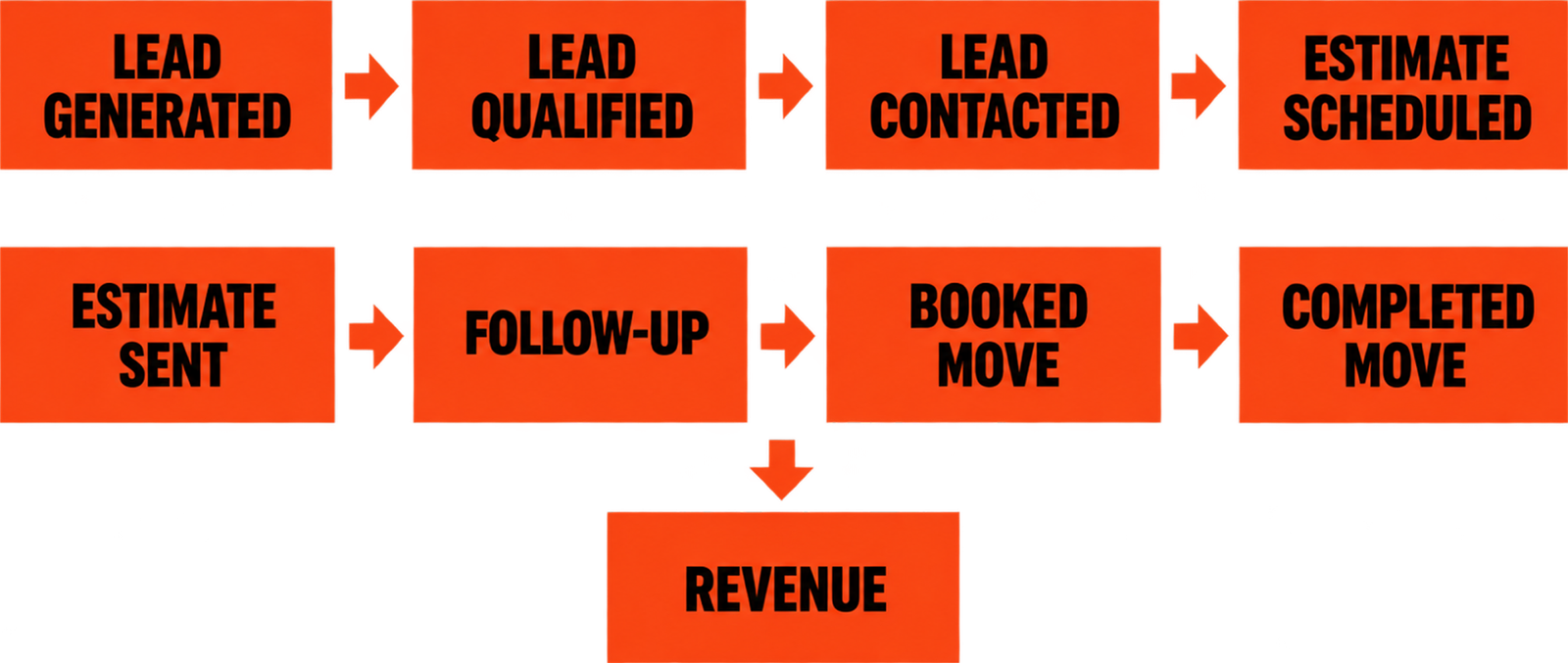
Every stage tells you something.
Lots of leads but few qualified leads?
Your targeting may be wrong.
Lots of qualified leads but few estimates?
Your response or qualification process may be weak.
Lots of estimates but few bookings?
Your pricing, sales presentation, trust signals, follow-up, or competitive positioning may need attention.
Lots of bookings but poor profitability?
Now the issue isn’t lead generation.
It’s economics.
That’s why a moving company shouldn’t ask only:
“How many leads did we get?”
It should ask:
“Where are our leads falling out of the funnel?”
The Real Question Isn't "How Many Leads Can We Buy?"
It’s:
“How many of the leads we’re already paying for are we actually converting?”
If you’re getting 20 legitimate moving opportunities and booking three, increasing your lead volume might not be your first priority.
You may need to figure out why 17 opportunities aren’t becoming customers.
If you’re getting 20 legitimate opportunities and booking 12, then additional qualified opportunities may have a very different economic value.
The answer isn’t the same for every moving company.
That’s why Movers Pro Marketing looks at the entire system rather than treating “more leads” as the automatic answer.
- Your marketing should create opportunities.
- Your website should build confidence.
- Your sales team should convert opportunities.
- Your follow-up should recover prospects who aren’t ready immediately.
- And your reporting should connect all of that to booked moves and revenue.
Final Takeaway
When you pay for a moving lead and your competitor gets the customer, don’t immediately blame the lead.
First find out what actually happened.
Was it:
- A bad lead?
- A shared lead?
- A slow response?
- Poor qualification?
- Weak follow-up?
- A confusing estimate?
- A trust problem?
- A pricing problem?
- A website problem?
- A salesperson problem?
Until you know the answer, buying more leads is a guess.
The moving companies that grow consistently aren’t necessarily the companies generating the most inquiries.
They’re the companies that understand what happens after the inquiry arrives.
A lead is an opportunity. A booked move is the result. Measure the difference.